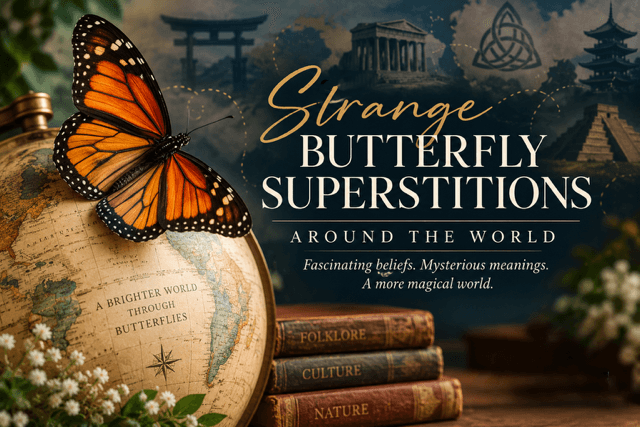
Butterfly superstitions have existed around the world for centuries. These delicate insects may be symbols of beauty and transformation today, but folklore has also cast them as wandering souls, supernatural messengers, omens of death, symbols of everlasting love and even predictors of the future.
And honestly, it makes sense.
Imagine living hundreds—or thousands—of years ago and watching a caterpillar disappear inside a chrysalis, only for a completely different, winged creature to emerge. Without our modern understanding of metamorphosis, that transformation must have seemed almost supernatural.
Cultures around the world found their own explanations.
Here are some of the strangest and most fascinating butterfly superstitions and legends that have survived through history.
Japan: A Butterfly Might Be Someone’s Soul
If a butterfly unexpectedly flew into your house, would you shoo it back outside?
According to old Japanese folklore, you might want to think twice.
Writer Lafcadio Hearn recorded several fascinating Japanese butterfly beliefs in his 1904 book Kwaidan: Stories and Studies of Strange Things. Among them was the belief that the soul of a living person could temporarily wander in the form of a butterfly.
A butterfly entering a room could therefore mean someone you loved was coming to see you.
Butterflies could also represent the dead. Hearn wrote of a belief that souls might take butterfly form when finally departing the body, which meant a butterfly entering the home should be treated kindly rather than harmed.
There was even a darker version of butterfly symbolism. According to Hearn, an enormous swarm of butterflies appearing in Kyoto before the revolt of Taira no Masakado was remembered as a frightening omen of the violence to come.
Beautiful? Absolutely.
A little creepy? Also absolutely.
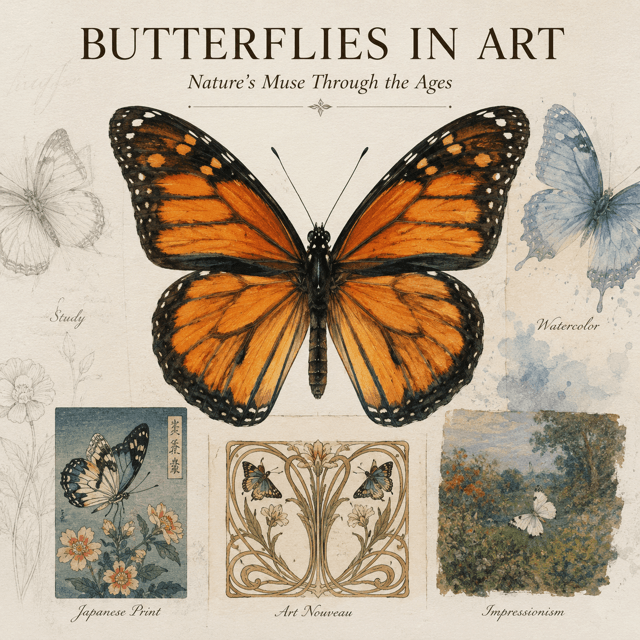
Explore more: Butterfly symbolism has appeared in artwork for centuries. Read Butterflies in Art: Where Science Meets Beauty.
Ireland: Whatever You Do, Don’t Kill the White Butterfly
Ireland gives us one of the most haunting butterfly superstitions of all.
White butterflies were traditionally associated with the souls of dead children. Historical accounts of Irish folklore describe butterflies more broadly as souls of the departed, including souls waiting to pass through Purgatory.
The belief surrounding white butterflies became especially powerful: killing one was considered deeply wrong because you might, in effect, be harming the spirit of a child.
The tradition appears in multiple collections and accounts of Irish folklore, including an extraordinary old tale collected by W.B. Yeats in which a white-winged creature rises from the body of a dead man and is recognized as his soul.
Suddenly that cabbage white fluttering through the garden feels a little different.
Explore more: Why are humans so emotionally drawn to these insects in the first place? We explored that question in Why Do We Love Butterflies?.
Ancient Greece: One Word for Butterfly and Soul
This may be one of the most important butterfly associations in Western history.
The ancient Greek word psyche was associated with the soul—and also came to be associated with the butterfly.
That connection was more than a pretty metaphor.
Ancient Greek and Roman artwork sometimes represented Psyche, the personification of the human soul, as a woman with butterfly wings. Classical sources also connected the butterfly with the soul of the dead.
Metamorphosis offered an almost perfect visual analogy: a caterpillar seemingly disappears, remains enclosed inside a chrysalis and then emerges as a winged creature.
To people trying to understand what happened to a human being after death, the comparison must have been irresistible.
The body remains behind.
Something else flies away.
Explore more: The relationship between butterflies, human emotion and symbolism continues today. Read Why Do We Love Butterflies?.
China: Two Butterflies and a Love That Refused to Die
Some butterfly folklore is spooky.
This one is heartbreakingly romantic.
One of China’s best-known traditional love stories is the legend of Liang Shanbo and Zhu Yingtai, commonly known as The Butterfly Lovers.
There are different versions of the centuries-old story, but the central tragedy remains: two young people fall in love but cannot be together. Liang dies, and Zhu ultimately joins him in death.
Then something extraordinary happens.
Two butterflies emerge and fly away together.
The pair represents the lovers finally united in a form in which no family, social expectation or earthly obstacle can separate them.
Over time, paired butterflies became associated with romantic love, marital happiness and fidelity in Chinese art and decorative traditions.
It may be one of the world’s loveliest explanations for why seeing two butterflies together feels special.
Explore more: See how butterflies have inspired artists across cultures and centuries in Butterflies in Art: Where Science Meets Beauty. Check out our shop to see our stunning collection of real butterfly framed art.
The Ozarks and Appalachia: Butterflies Could Tell Your Fortune
Not every butterfly superstition involved wandering souls.
Sometimes people apparently just wanted butterflies to tell them what was going to happen next.
American folk traditions contain numerous beliefs involving butterfly color, appearance and behavior.
In the Ozarks, for example, the mourning cloak—one of the earliest butterflies to appear after winter—became associated with the arrival of spring.
Appalachian folklore also assigned meaning to the markings on butterflies. One recorded tradition held that the number of spots visible on a fritillary could predict how much money a person might receive.
It’s basically a tiny, winged financial adviser.
Whether anyone actually collected their butterfly-predicted fortune is another question.
What these traditions reveal, though, is something humans have done for thousands of years: watch nature closely and turn its patterns into signs.
Explore more: Today butterflies tell scientists something far more useful than our future bank balance. Museum specimens provide valuable historical information about species and environmental change. Read How Museum Butterfly Collections Help Protect Species.
Dark Butterflies: Why Black Wings Became Bad Omens
Across folklore, color frequently changes the meaning assigned to a butterfly.
White and brightly colored butterflies have often been connected with souls, good fortune, spring or hope.
Dark butterflies and moths haven’t always been so lucky.
Black and brown butterflies have accumulated associations with death, difficult times and bad news in various folk traditions. Some of this probably reflects a broader human tendency to associate darkness and nighttime creatures with uncertainty or danger.
There’s an important wrinkle here, though:
Many creatures described as “butterflies” in supernatural stories are actually moths.
And few demonstrate the confusion better than the enormous black witch moth (Ascalapha odorata), a dramatic dark moth found throughout parts of the Americas.
With a wingspan that can approach seven inches, it’s easy to imagine how one of these enormous nighttime visitors appearing unexpectedly at a door or window could inspire a supernatural explanation.
The moth is harmless.
Its reputation hasn’t always been.
When a Butterfly Becomes a Message
What’s fascinating isn’t whether any of these superstitions are literally true.
It’s how often completely different cultures arrived at remarkably similar ideas.
Again and again, butterflies became connected with:
- souls and the afterlife
- visits from the dead
- love and marriage
- transformation
- good or bad fortune
- warnings and omens
- rebirth and renewal
That probably isn’t an accident.
Few animals undergo a transformation as visually dramatic as a butterfly.
A caterpillar crawls into a chrysalis. It disappears from view. Then a creature with wings emerges from what appears to be the same shell.
Today we can explain what happens biologically.
For most of human history, people couldn’t.
So they explained it with stories.
The Science Is Incredible Enough
Ironically, understanding butterfly metamorphosis scientifically doesn’t make it any less extraordinary.
Inside the chrysalis, the caterpillar undergoes an enormous biological reorganization. Adult structures develop, wings form and an animal built primarily for crawling and eating emerges equipped to fly and reproduce.
No wandering soul is required.
But it’s easy to understand why our ancestors thought one might be involved.
And perhaps that’s what makes old butterfly superstitions so fascinating. They aren’t really stories about insects.
They’re stories about us—about how human beings have tried to understand love, death, change, luck and the things we couldn’t explain.
The butterfly simply gave those mysteries wings.
Keep Exploring the Strange World of Butterflies
Butterflies have been inspiring science, art, mythology and curiosity for thousands of years—and there are plenty more strange stories where these came from.
Explore more butterfly history, science and curiosities in The Butterfly Connection Blog.
And the next time a butterfly unexpectedly flies through an open door?
Science says it probably got lost.
Folklore says you might want to see who stopped by.