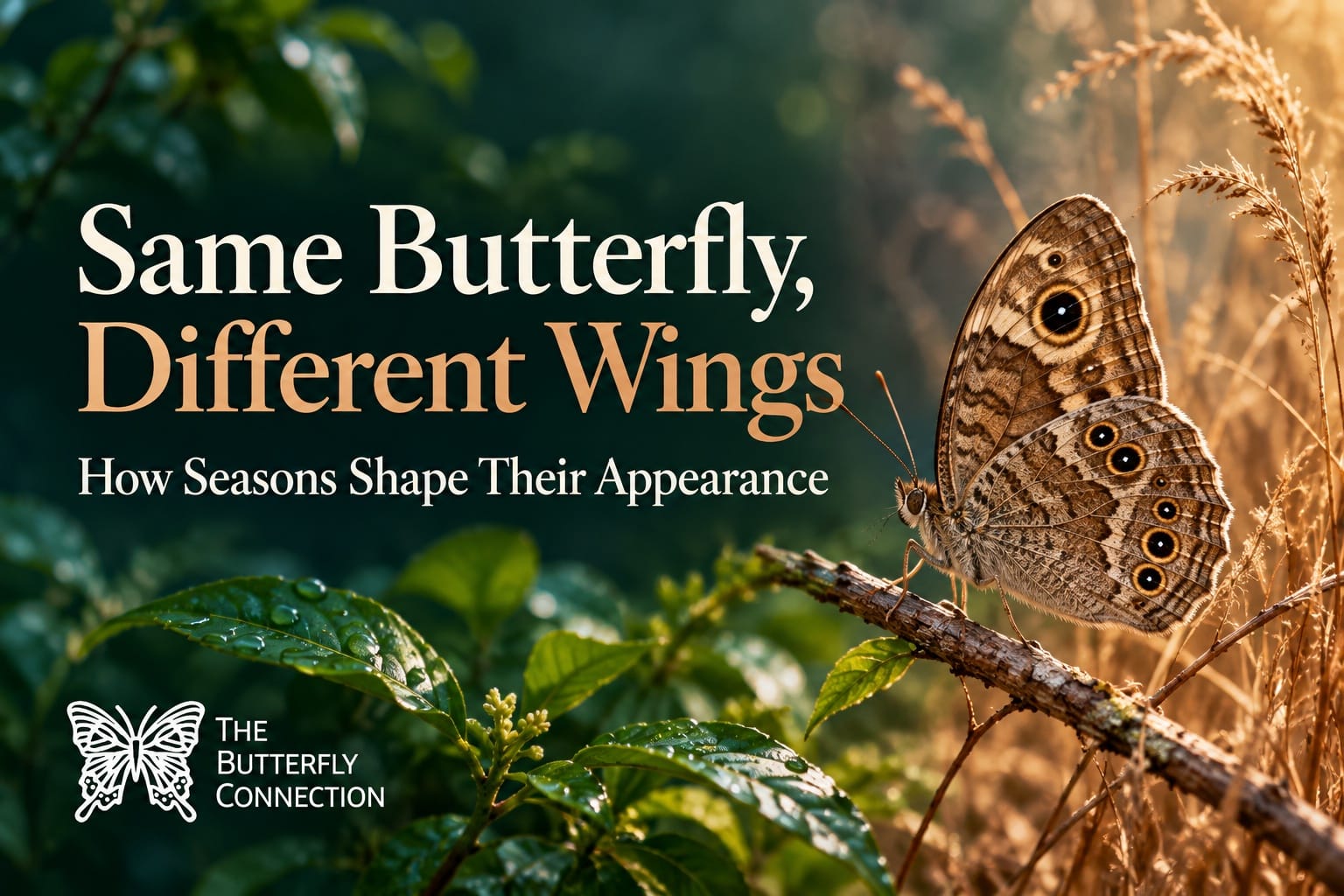
Imagine looking at two butterflies of the same species. One has bold, eye-catching spots along its wings. The other looks quieter, its markings reduced against a brown background.
You might assume they are different species, or that one has simply lost its color. But in some butterflies, the explanation begins with the conditions they experienced while growing.
Seasonal butterfly wing changes can produce different-looking adults at different times of year. The result is a fascinating reminder that identifying a butterfly involves more than matching a single photograph.
There is one important distinction: an adult butterfly is not putting on a new seasonal pattern. These differences develop before it emerges. “Same butterfly” means the same species, seen in different seasonal forms.
What causes seasonal butterfly wing changes?
Scientists use the term seasonal polyphenism when environmental conditions help produce distinct seasonal forms within a species. It is one expression of developmental plasticity: the ability to develop differently under different conditions.
A familiar research example is Bicyclus anynana, an African butterfly studied for its wing eyespots. Researchers have produced contrasting seasonal forms by raising developing butterflies at different temperatures.
In a study published in Heredity, the wet-season form had conspicuous markings and large eyespots, while the dry-season form had a much less conspicuous appearance. Temperature during development was a major cue controlling that difference.
The butterfly does not need to recognize a date on a calendar. Conditions experienced during growth can influence the adult pattern it develops.
For someone looking at a display, that opens an interesting question. A pattern is something to admire, but it can also be a clue to the developmental history of the animal carrying it.
A wing pattern begins before the wings unfold
The timing of those environmental cues matters.
In experiments on Bicyclus anynana, researchers moved developing insects between warmer and cooler conditions to identify sensitive periods. They found that late caterpillar development was especially important, with sensitivity also extending into the very early pupal stage.
Their study of the critical period for wing-pattern induction shows why the adult is only the visible endpoint of a longer process.
By the time you see the butterfly, part of its story has already unfolded out of sight. The wing pattern reflects events during development, rather than a change the adult makes when a wet or dry season arrives.
That distinction is useful when comparing photographs. A newly emerged butterfly with smaller eyespots is not necessarily an older version of one with larger spots.
Why might a larger eyespot matter?
An eyespot looks decorative to us. To a predator, its position may influence where an attack lands.
In experiments involving Bicyclus anynana and praying mantids, researchers found that conspicuous eyespots on the underside of the hindwings helped direct attacks toward the wing area and away from more vulnerable parts of the butterfly. The work provides evidence that a wing pattern can affect survival in a particular predator encounter.
The published eyespot study connects a visible detail with a measurable function.
It does not establish that larger spots are best for every butterfly in every setting. The value of a pattern depends on circumstances, including which predator is involved. But it gives us a compelling reason to look beyond the idea of wings as decoration.
A small circle near a wing’s edge can be part of a much larger interaction.
Buckeyes offer another seasonal surprise
Seasonal differences can involve background color as well as the size of a marking.
Research on the buckeye butterfly, described under the name Precis coenia in a 1995 paper, examined light and dark seasonal forms. The underside wing surfaces were light beige in the form associated with warm, long-day conditions and dark reddish-brown in the form associated with cool, short-day conditions.
The study recorded by Duke University also investigated hormonal control of those differences.
This adds another layer to the story: environmental conditions and the butterfly’s developmental processes work together. A seasonal form is more than a coat of color applied at the end.
When comparing buckeye photographs, checking the underside of the wings may reveal differences that are less obvious in a view from above.
Do all butterflies have seasonal forms?
No. The examples above should not become a rule for every butterfly you encounter.
A 2024 study compared eyespot plasticity across Bicyclus butterflies using museum specimens and information about their environments. Species from highly seasonal habitats showed strong plasticity, while those from less seasonal habitats varied considerably.
The research published in Evolution shows why species and habitat matter. Even within a related group, butterflies do not all respond in exactly the same way.
Differences between two specimens may also call for other explanations. Before deciding that a pattern is seasonal, confirm the identification and look for research about that species.
One striking example can introduce a question. It cannot answer it for every pair of wings.
Look closely at the details in butterfly art
The next time you study a butterfly, try looking at one feature at a time. Follow a band across the wing. Compare the size of the spots. Notice which details belong to the upper surface and which appear underneath.
At The Butterfly Connection, our framed butterfly art offers an opportunity to slow down and appreciate those visible patterns. Our Blue Morpho frame is another invitation to look closely at a butterfly’s individual details; it is not presented here as an example of the seasonal forms discussed above.
The more carefully you look, the more questions a wing can raise. Sometimes the answer lies in the species. Sometimes it lies in how the butterfly developed before you ever saw it.
That is part of the pleasure of natural history: a familiar shape can still hold an unfamiliar story.
Frequently asked questions
Does an adult butterfly change its wing pattern with the seasons?
The seasonal forms described here develop before the adult emerges. They are different developmental outcomes within a species, rather than an adult switching between patterns.
What does seasonal polyphenism mean?
It describes distinct seasonal forms produced within a species in response to environmental conditions during development.
Can temperature affect butterfly eyespots?
Yes. In Bicyclus anynana, developmental temperature can influence adult eyespot size. Responses differ among species, so this should not be assumed for every butterfly.
Are the same cues important in every species?
No. The examples in this article involve temperature and, in buckeyes, day length. Which cues matter and when they act must be established for the species being studied.