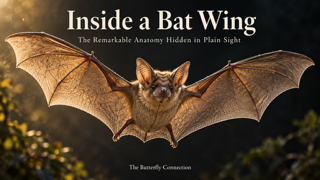
A bat passing overhead can look like a single dark shape: pointed wings, a quick turn, and then nothing but night sky.
Slow that moment down, and an extraordinary structure comes into view.
Bat wing anatomy begins with something surprisingly familiar—a mammal’s forelimb. Beneath that unmistakable silhouette are fingers, joints, and flexible tissue arranged into a remarkable system for flight.
October gives us plenty of reasons to decorate with bats. Their anatomy gives us a reason to look closer.
Bat wing anatomy starts with a hand
Hold up your hand and spread your fingers. Now imagine those fingers stretched into long supports, with a flexible membrane spanning the spaces between them.
You have the beginnings of a bat wing.
As Bat Conservation International explains, elongated fingers support much of the wing’s surface. Moving those fingers allows a bat to change its wing shape during flight. (batcon.org)
Once you recognize that arrangement, the outline becomes easier to read. Those slender supports radiating through the wing belong to a modified hand.
Try following them in a clear photograph or a preserved specimen. The familiar Halloween shape suddenly becomes something much more intriguing.
A flexible membrane with a demanding job
The surface between those supports is living tissue containing blood vessels, connective tissue, and small muscles. Its flexibility allows the wing to bend and change shape as the bat moves through the air. (batcon.org)
Picture the difference between holding a flat sheet of paper and gently curving it in your hands. The shape changes how it meets the air. A bat manages a much more complex version of that challenge with every wingbeat.
That makes the wing’s delicate appearance especially striking. Looking at its thin membrane, it is easy to overlook how much work the entire structure performs.
Tiny muscles help fine-tune flight
Some of the wing’s most interesting features are too small to appreciate in an ordinary display.
Brown University researchers studying Jamaican fruit bats recorded activity in nearly hair-thin muscles embedded in the wing membrane. Their findings showed these muscles working together during flight, helping adjust the membrane’s stiffness and shape.
The muscles followed a pattern: they became active around the downstroke and relaxed during the upstroke, with timing changing at different flight speeds.
Brown’s research on tiny wing muscles reveals how much fine control can be hidden within a seemingly simple surface.
A quick glimpse overhead gives us the outline. Scientific research reveals the adjustments happening inside it.
Bat wings can sense the air
A bat’s wings also gather information.
Microscopic hairs associated with touch receptors help bats detect airflow over their wing surfaces. That sensory feedback contributes to their ability to control movement through the air.
In experiments, removing these hairs affected how bats maneuvered around obstacles. Bat Conservation International explores this research in “Touch the Sky.” (batcon.org)
It is a fascinating detail to consider the next time you watch a bat turn against the evening sky. The wing is moving through the air while helping the animal sense what that air is doing.
What a resin-encased bat invites you to notice
A flying bat rarely gives you time to study its proportions. A preserved specimen offers a still view, allowing you to follow the wing’s outline and examine visible structures at your own pace.
Start with the body, then trace the supports outward. Notice how their lengths shape the wing. Look at the relationship between the narrow bones and the broader membrane they support.
Our introduction to resin-encased bats offers a closer look at these unusual additions to The Butterfly Connection.
The microscopic hairs and active muscle systems described here require scientific equipment and research to investigate. A specimen offers a starting point for curiosity: a chance to look carefully, recognize familiar anatomy, and ask what each structure does.
That same curiosity draws people to butterfly art and butterfly-wing jewelry. A shape or pattern catches your attention first. The longer you look, the more questions it gives you.
Look beyond the silhouette
Bats will always have a place among October’s pumpkins, moonlit windows, and spooky decorations. But their wings hold a story that lasts far beyond Halloween.
Recognizing the hand inside the wing changes how you see the entire animal. Each slender support becomes part of a structure built for movement, flexibility, and control.
Explore resin-encased bats at The Butterfly Connection, and take a closer look at the details behind that unforgettable silhouette.
Frequently asked questions
Do bats have fingers in their wings?
Yes. Elongated fingers help support much of a bat’s wing membrane.
What is a bat’s wing membrane made of?
It is living tissue containing blood vessels, connective tissue, nerves, and small muscles.
Can you see all these features in a preserved specimen?
A specimen may reveal the wing’s outline and visible supports. Microscopic structures and the mechanisms operating during flight require specialized study.