

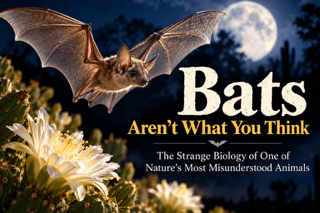
There are few animals with a worse public-relations problem than the bat.
For centuries, bats have been associated with darkness, vampires, haunted houses, bad omens and things that generally go bump in the night.
October certainly hasn’t helped.
Every fall, bats appear on Halloween decorations alongside skeletons, witches and ghosts—as though simply being a small mammal that prefers the night shift automatically makes you terrifying.
But take away the folklore and horror movies, and the real animal is much more interesting.
Bats are the only mammals capable of true powered flight. Some navigate and hunt using extraordinarily sophisticated biological sonar. Others pollinate flowers, disperse seeds or consume enormous numbers of insects. Some migrate. Others hibernate. And despite the stereotype of the sinister blood-drinking bat, the overwhelming majority have absolutely no interest in drinking blood.
There are more than 1,300 bat species worldwide, and they have evolved into one of the most diverse groups of mammals on Earth. (National Park Service)
So perhaps bats aren’t frightening.
Perhaps they’re just profoundly misunderstood.
First Things First: Bats Aren’t Flying Mice
This misconception has been surprisingly persistent.
Bats are mammals, but they aren’t rodents. They belong to their own order, Chiroptera, a name derived from Greek words meaning “hand” and “wing.”
That name is remarkably accurate.
Look carefully at the skeleton inside a bat wing and you’ll find something that looks strangely familiar: an arm, wrist and dramatically elongated fingers.
A thin, flexible membrane stretches across those bones to create the wing.
In other words, a bat essentially flies with its hands.
And it really does fly.
Flying squirrels and other so-called flying mammals actually glide. Bats are the only mammals that evolved the anatomy necessary for sustained powered flight. (Smithsonian Institution)
That alone should earn them considerably more respect.
But things get stranger.
A Bat Can Build a Picture of the World Using Sound
Imagine walking through a completely dark room.
Now imagine doing it while flying.
Then imagine detecting an insect smaller than your thumb, calculating where it’s moving and intercepting it in midair—all within seconds.
Many bats routinely accomplish something remarkably close to this through echolocation.
A bat produces high-frequency sounds and listens for the echoes that return after those sounds encounter objects. Information contained in those echoes helps the animal interpret its surroundings and locate prey.
It’s sometimes described simply as “seeing with sound,” but that phrase barely captures how sophisticated the process can be.
Researchers continue discovering just how remarkable bat echolocation really is.
In research announced by the Smithsonian Tropical Research Institute in January 2026, scientists even used a robotic system to investigate how common big-eared bats can detect silent insects sitting on leaves in cluttered rainforest environments. The work helped researchers understand how bats may use echoes bouncing from leaves to distinguish potential prey. (Smithsonian Institution)
Modern researchers also use bats’ own sounds to study them. Because many species are difficult to observe at night, scientists can place acoustic detectors in their habitats and identify or monitor bats by recording their calls. (Bat Conservation International)
Nature developed a remarkably sophisticated biological sonar system long before humans ever invented one.
But Bats Aren’t Blind
Here is another myth worth retiring.
Bats can see.
Different species rely on vision to different degrees, and many echolocating bats combine hearing, vision and other sensory information to understand their surroundings.
The expression “blind as a bat” makes for a memorable saying.
It just isn’t a particularly accurate biology lesson.
Their Wings Are Even Stranger Than They Look
A bird wing and a bat wing can accomplish the same basic task, but evolution arrived at two very different designs.
Bird wings are dominated by feathers.
Bat wings consist of flexible skin stretched over elongated bones.
Those finger-like structures give bats extraordinary control over the shape of their wings during flight.
Watch one closely and the movement can look almost impossibly agile: banking, turning, accelerating and changing direction while pursuing insects through the night.
Some bats can hover near flowers. Others specialize in snatching insects from surfaces. Some even capture fish.
There isn’t one standard “bat lifestyle.”
There are hundreds upon hundreds of variations.
Not Every Bat Eats Insects
Ask someone what bats eat and mosquitoes will probably be one of the first answers.
And yes, many bats are insect eaters.
That’s an enormously important ecological job. Insect-eating bats consume night-flying insects, including species considered agricultural pests. The National Park Service notes that bats provide important ecosystem services through insect consumption. (National Park Service)
But insect hunting is only part of the story.
Depending on the species, bats may eat:
● insects
● fruit
● nectar
● pollen
● fish
● frogs or other small animals
And yes, there are vampire bats.
But only three species feed on blood.
With more than 1,300 bat species around the world, the famous vampire lifestyle represents a tiny fraction of bat diversity.
Hollywood simply gave those three species exceptionally good publicity.
Some Bats Are Pollinators
This is where bats and butterflies have more in common than you might expect.
Pollination doesn’t stop when the sun goes down.
In parts of the world where nectar-feeding bats occur, bats take over the night shift.
Flowers adapted for bat pollination often open at night. A bat arrives looking for nectar, brushes against pollen and carries it onward as it visits other flowers.
In the southwestern United States and Mexico, the lesser long-nosed bat provides a particularly beautiful example.
These bats feed from night-blooming cacti and agaves using elongated, brush-tipped tongues. As they feed, their heads and bodies collect pollen that is transported between flowers.
They are important pollinators of plants including saguaro and organ pipe cactus. (National Park Service)
That makes the relationship between butterflies and bats an interesting one.
Butterflies are among the familiar faces of daytime pollination.
Some bats continue that ecological work after dark.
Different animals. Different shifts.
Same interconnected natural world.
Hanging Upside Down Actually Makes Sense
Of all the things bats do, hanging upside down may be the behavior that makes them look most alien.
But there is a practical reason for it.
Flight requires lift, and bats don’t launch themselves exactly like birds. Hanging from an elevated position allows many bats to release their grip, drop into the air and begin flying.
Their feet and legs are also specially adapted for roosting.
What looks uncomfortable to us is perfectly ordinary bat behavior.
Their roosts vary tremendously as well.
Depending on the species, bats may spend their days in caves, hollow trees, rock crevices, beneath bark, in mines or inside human structures such as barns and buildings. (Smithsonian Institution)
And some bats return repeatedly to familiar roosting areas.
Home, apparently, is important even when you sleep upside down.
Some Bats Hibernate. Others Migrate.
Butterfly lovers know that migration isn’t limited to birds.
Neither is it limited to butterflies.
Some bat species undertake seasonal migrations, while others survive winter by hibernating. Certain species may use combinations of movement and periods of torpor depending on conditions.
The hoary bat, for example, migrates seasonally across North America and can also hibernate for shorter periods. (Bat Conservation International)
That means autumn skies contain more movement than most of us ever notice.
While monarch butterflies are heading south in daylight, bats may be making seasonal journeys of their own after sunset.
Two completely different creatures.
Two extraordinary solutions to the same basic challenge: surviving a changing season.
Bats Live Surprisingly Long Lives
Small mammals generally aren’t famous for longevity.
Bats break that expectation too.
Some bat species can live for decades, with the National Park Service noting lifespans reaching 35 years in some species. (National Park Service)
That is especially remarkable considering their size and extremely active lifestyles.
They also tend to reproduce slowly.
Many species produce only one pup each year, although reproductive strategies vary among species.
That combination—long lives and relatively slow reproduction—also means bat populations may have difficulty recovering quickly when large numbers disappear.
And Some Bat Populations Are in Serious Trouble
One of the biggest threats facing North American bats is something most people had never heard of a few decades ago.
White-nose syndrome is a disease caused by a fungus that affects hibernating bats.
It has devastated populations of several species, particularly in eastern North America, and scientists continue studying and monitoring affected populations. (National Park Service)
Other bat species face pressures from habitat loss and other environmental changes.
And because bats spend so much of their lives hidden from us—flying at night, roosting in secluded spaces and communicating at frequencies we often cannot hear—it can be surprisingly difficult to understand what is happening to a population until researchers deliberately go looking.
That is one reason acoustic monitoring and other modern research techniques have become so valuable.
Maybe the Darkness Was Never the Problem
There is an interesting contrast between butterflies and bats.
Butterflies live much of their visible lives in sunlight.
We see the colors. We watch them visit flowers. We associate them with gardens, transformation and beauty.
Bats emerge when most of us are going inside.
We see silhouettes.
We hear wings.
And historically, humans filled in everything we couldn’t see with stories.
Sometimes those stories became legends.
Sometimes they became fear.
But science has slowly replaced many of those old assumptions with something far more interesting.
A bat isn’t simply a shadow crossing the evening sky.
It’s a mammal flying on elongated fingers.
It’s an animal that may construct a detailed picture of its surroundings from echoes.
It might spend the night hunting insects, pollinating flowers or carrying seeds across a landscape.
It may travel hundreds of miles with the changing seasons.
And somewhere above us after sunset, it is participating in an ecosystem that continues operating long after we’ve stopped watching.
That seems considerably more fascinating than the monster we’ve made it out to be.
See One Up Close
Part of what makes natural specimens so fascinating is the opportunity to notice details that are almost impossible to see when an animal is moving.
That’s particularly true of bats.
Their delicate wing membranes, elongated fingers and unusual anatomy become much easier to appreciate when you can actually stop and look.
The Butterfly Connection has previously explored the story behind our resin-encased bats, which allow those remarkable anatomical features to be viewed up close.
Read: Not Just Butterflies—Resin Encased Bats Have Landed at The Butterfly Connection
And if your curiosity extends beyond bats, you can explore The Butterfly Connection and discover more of the extraordinary forms, colors and structures nature has created.
Because sometimes the animals we understand least are the ones worth looking at a little more closely.
Frequently Asked Questions About Bats
Are bats blind?
No. Bats can see. Many species also use echolocation to navigate and locate prey, but echolocation doesn’t mean they lack vision.
Are bats rodents?
No. Bats belong to the mammalian order Chiroptera. They are not mice or other rodents.
Are bats the only flying mammals?
Yes. Bats are the only mammals capable of sustained powered flight. Animals such as flying squirrels glide rather than truly fly.
Do all bats use echolocation?
No. Bat sensory systems vary among species. Echolocation is especially important to many species that hunt insects and navigate at night.
Do all bats drink blood?
Absolutely not. Only three bat species feed on blood. Other bats eat insects, fruit, nectar, pollen, fish and other foods.
Do bats pollinate flowers?
Yes. Nectar-feeding bats are important pollinators in several ecosystems. In the southwestern United States, for example, lesser long-nosed bats pollinate plants including saguaro and organ pipe cacti.
Why do bats hang upside down?
Their anatomy makes hanging an efficient way to rest, and an elevated roost allows many bats to drop into the air when beginning flight.
Share:
Facebook
Twitter
Pinterest
Email


Social Media
Most Popular
Get The Latest Updates
Subscribe To Our Newsletter
No spam, notifications only about new products, updates.
Categories
On Key
Related Posts
Bats Aren’t What You Think: The Strange Biology of One of Nature’s Most Misunderstood Animals
There are few animals with a worse public-relations problem than the bat. For centuries, bats have been associated with darkness, vampires, haunted houses, bad omens

The Secret Overnight Hotels of Monarch Butterflies
The Secret Overnight Hotels of Monarch Butterflies Imagine walking past an ordinary-looking tree at sunset. At first, nothing seems unusual. Then you notice something hanging
Scientists Are Putting Tiny Transmitters on Monarch Butterflies—Here’s What They’re Discovering
Imagine trying to follow a butterfly. Not for a few minutes through a garden, but for miles—as it crosses neighborhoods, farmland, highways and eventually entire
Strange Butterfly Superstitions Around the World
Butterfly superstitions have existed around the world for centuries. These delicate insects may be symbols of beauty and transformation today, but folklore has also cast