At first glance, a glasswing butterfly can look as though someone forgot to fill in its wings. A delicate brown outline frames clear panels, and the leaf or flower behind the butterfly remains visible through them.
Look again. Those clear spaces are part of a complete, functioning wing.
The glasswing butterfly, Greta oto, offers one of the most surprising sights in the butterfly world: an animal whose beauty comes partly from how little of it you can see.
For anyone accustomed to bold monarch stripes or a morpho’s brilliant blue, it raises an irresistible question. How does a butterfly make a wing transparent—and keep sunlight from turning it into a tiny flashing mirror?
Meet the glasswing butterfly
Greta oto is a tropical butterfly with large transparent areas bordered by darker markings. In photographs, those clear panels can seem almost unreal. The veins remain visible, tracing fine lines across a surface that lets the background show through.
The effect makes you slow down. Your eyes recognize the butterfly’s outline, then try to reconcile that outline with the scenery inside it.
Scientists have been drawn to the same puzzle. Researchers working with the Marine Biological Laboratory studied how these transparent regions develop, following changes from the pupal stage into the adult wing.
Their work reveals that producing a clear wing requires several features to come together. The butterfly must leave a path for light to pass through while limiting the reflections that could reveal the surface. (mbl.edu)
How does a glasswing butterfly get transparent wings?
Most familiar butterfly wings have a dense covering of scales. These tiny structures help create the colors and patterns we notice from a distance.
In the clear areas of a glasswing’s wings, the arrangement is different. Scientists found fewer developing scale cells, and the scales that form there are narrow and bristle-like rather than broad and closely overlapping.
More of the underlying wing membrane is exposed, allowing light to pass through.
The Marine Biological Laboratory’s explanation of glasswing development describes how researchers used microscopy to follow this process. (mbl.edu)
Imagine looking through a window with a heavy curtain, then replacing the curtain with a few widely spaced threads. The glasswing’s scale arrangement creates a similar opening for light.
That comparison explains part of the effect. But a bare, clear surface can still catch the sun.
The problem with being see-through: glare
You have probably looked through a window and suddenly noticed your own reflection. The glass was transparent the entire time, yet the lighting made its surface obvious.
A glasswing faces a related optical problem. Letting light through a wing does not automatically prevent light from reflecting off it.
Researchers investigating Greta oto found an additional feature: extremely small structures on the wing surface, including wax-based pillars, that reduce reflection.
In the published study, removing that waxy layer increased the wing’s reflectivity. The experiment helped demonstrate that the surface structures contribute to the disappearing effect. (pmc.ncbi.nlm.nih.gov)
Think of the difference between a clear window that flashes in sunlight and one whose surface produces much less glare. Both transmit light, but one announces its presence more readily.
A glasswing’s transparency depends on both what light can pass through and what the surface sends back.
Does transparency make the butterfly invisible?
“Invisible butterfly” makes a memorable nickname, but it is an exaggeration.
The body, wing borders, and veins remain visible. Movement and lighting can also reveal the animal. Transparency reduces the visual presence of parts of the wing; it does not erase the entire butterfly. (pmc.ncbi.nlm.nih.gov)
Still, imagine trying to follow a small moving animal through layered vegetation when much of its wing area lets the background show through. There is less solid, opaque surface for your eye to hold onto.
That is what makes the glasswing so compelling to watch. You can recognize it perfectly well in one view and find its outline surprisingly difficult to follow in another.
For a viewer, the experience feels like a small visual trick. For researchers, it creates questions about camouflage, light, and how animals perceive one another.
Other butterflies have found their own ways to disappear
Glasswing is a common name, and Greta oto is one member of a much wider world of transparent-winged butterflies and moths.
Scientists comparing transparency across 123 species found a diversity of structural solutions. Clear wings have likely evolved independently more than once.
Research also complicates the idea that transparency serves only concealment. Among some species, transparent wing patterns can participate in mimicry systems associated with predator avoidance.
The Marine Biological Laboratory’s overview of transparent butterflies and moths explores those findings. (mbl.edu)
That variety matters. Two butterflies with clear wings may look as though they have arrived at the same answer, yet the details of their scales and surfaces can differ.
It is a good reason to look closely at the species name beneath a photograph. The shared appearance is the beginning of the story, rather than proof that every glasswing works identically.
What clear wings can teach us about materials
Researchers are interested in transparent butterflies for reasons that reach beyond natural history.
A surface that transmits light while controlling reflection could offer useful ideas for human-made materials. Studying the wing helps scientists ask which features matter, how they interact, and whether similar structures can be made in the laboratory.
One study inspired by the longtail glasswing butterfly, Chorinea faunus, investigated artificial nanostructured surfaces for medical-device applications. (pmc.ncbi.nlm.nih.gov)
That is a different species from Greta oto, with its own wing features. It is also a concrete example of why scientists examine these small structures so carefully.
A butterfly wing can be both an extraordinary biological object and a starting point for a new research question. The fascination comes from following the details far enough to discover what they can explain.
A different way to appreciate butterfly art
Glasswings broaden the idea of what makes a butterfly beautiful.
Color may be the first thing that draws us toward a display, but shape, spacing, symmetry, and the relationship between a wing and its background can be just as absorbing.
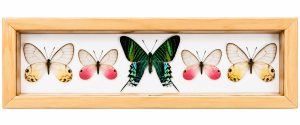
At The Butterfly Connection, our real butterfly art invites that closer observation. Follow a wing’s outline. Look at the placement of its markings. Notice how the smallest details change the impression of the whole piece.
Our butterfly-wing jewelry offers another way to appreciate natural patterns at a smaller scale.
The glasswing gives us a particularly memorable reason to pause. Its clear panels turn the background into part of the viewing experience, making even an apparently empty space worth a second look.
Explore The Butterfly Connection’s butterfly art and jewelry, and discover which details catch your eye.
Frequently asked questions
Are glasswing butterfly wings actually clear?
Large regions of Greta oto wings are transparent. Darker borders, veins, and the butterfly’s body remain visible.
Are the transparent sections holes?
No. They contain wing membrane. The clear appearance comes from the wing’s structure, including reduced scale coverage and surfaces that limit reflection. (pmc.ncbi.nlm.nih.gov)
Are all glasswing butterflies the same species?
No. Several butterflies have transparent wings, and common names can overlap. This article focuses mainly on Greta oto. (mbl.edu)
Why doesn’t a glasswing’s wing shine like a window?
Tiny surface structures help reduce reflection. In Greta oto, wax-based nanopillars contribute to that effect. (pmc.ncbi.nlm.nih.gov)