Butterflies Have Been Artists’ Subjects for Centuries
Long before cameras existed, artists played an essential role in documenting the natural world. Butterflies, with their remarkable colors, intricate wing patterns, and incredible diversity, became some of the most carefully studied and illustrated insects in history.
Many of the earliest butterfly illustrations weren’t created simply for decoration—they were scientific records used to identify species, document life cycles, and advance our understanding of the natural world.
Before Photography, Art Was Science
In the 1600s and 1700s, naturalists relied on detailed illustrations to record newly discovered species.
One of the most influential figures was Maria Sibylla Merian, whose meticulous paintings documented butterflies, caterpillars, and host plants together—something that was revolutionary at the time. Her work demonstrated that butterflies develop through complete metamorphosis and helped change the scientific understanding of insects.
Today, many of her original works are preserved in museums and libraries around the world.
Learn more about Merian’s work through the Getty Museum.
Accuracy Matters
Scientific butterfly illustration demands extraordinary precision.
Unlike decorative artwork, every detail matters:
- Wing shape
- Vein structure
- Color placement
- Antenna shape
- Body proportions
- Scale patterns
Before digital photography, these illustrations were often the most accurate references available to scientists studying butterflies around the world.
Butterflies Continue to Inspire Natural History Artists
Although photography has transformed scientific documentation, illustrated butterflies remain important.
Artists continue to create detailed works for:
- Field guides
- Museum exhibits
- Educational publications
- Scientific journals
- Botanical gardens
- University collections
Many illustrators still work directly from preserved museum specimens to capture details that photographs sometimes miss.
The Smithsonian National Museum of Natural History maintains extensive insect collections that support ongoing research and education.
Butterfly Art Beyond Science
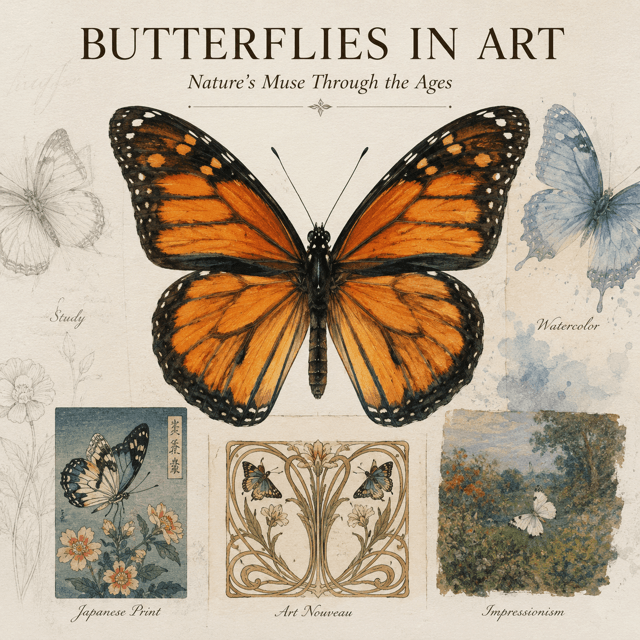
Butterflies eventually became popular subjects beyond scientific illustration.
Their symmetrical wings, vivid colors, and nearly endless variety made them favorites of painters, printmakers, textile designers, jewelers, and decorative artists.
During the late 19th century, butterflies appeared frequently in the flowing designs of the Art Nouveau movement, where artists celebrated organic forms inspired by nature.
Today, butterfly imagery continues to appear in everything from watercolor paintings and fine art prints to home décor and contemporary design.
Museums Preserve Both Art and Specimens
Natural history museums often display butterfly illustrations alongside preserved specimens.
Together, they tell a more complete story.
The specimen shows the butterfly exactly as it exists in nature, while the illustration highlights details that help viewers understand its anatomy, coloration, and identifying characteristics.
This partnership between science and art continues to educate millions of visitors every year.
The American Museum of Natural History and The Natural History Museum, London both feature remarkable collections that combine scientific research with public education.
Appreciating Nature’s Original Artwork
Artists have spent centuries studying butterflies because they represent some of nature’s most intricate designs.
Whether carefully illustrated in a scientific journal, painted on canvas, or professionally preserved for display, butterflies continue to remind us that the natural world is filled with extraordinary detail and beauty.
At The Butterfly Connection, we celebrate that same appreciation by offering professionally framed butterfly specimens that showcase the remarkable colors and patterns created by nature itself.
Frequently Asked Questions
Why were butterflies illustrated before photography?
Scientists relied on detailed artwork to identify species, document life cycles, and share discoveries long before cameras were available.
Who was Maria Sibylla Merian?
Maria Sibylla Merian was a 17th-century naturalist and scientific illustrator whose detailed studies of butterflies and other insects transformed the understanding of metamorphosis.
Are butterfly illustrations still used today?
Yes. Scientific illustrations remain valuable for field guides, museum exhibits, educational materials, and research publications.
Why are butterflies popular subjects in art?
Their symmetry, vibrant colors, and incredible diversity make butterflies both scientifically fascinating and visually striking.