Butterflies are often seen as symbols of beauty and transformation—but beneath their delicate wings lies a surprising scientific truth. Research shows that butterflies are capable of learning, forming memories, and even retaining information through one of the most extreme biological changes on Earth: metamorphosis.
So, do butterflies really have memory?
Science says yes—and the findings are reshaping how researchers understand insect intelligence.
🧠 Inside the Butterfly Brain
Butterflies have small brains, but they are far from simple. Their nervous systems include specialized regions known as mushroom bodies, which play a critical role in learning and memory. These structures are also found in bees, ants, and fruit flies and are widely studied by neuroscientists.
According to the Smithsonian National Museum of Natural History, mushroom bodies help insects process sensory information, associate experiences with outcomes, and adapt behavior accordingly.
Despite their size, butterfly brains are efficient, adaptable, and remarkably resilient.
🧪 Can Butterflies Learn? Science Says Yes
Scientists study butterfly learning through associative learning experiments, where butterflies are trained to associate specific cues—such as colors or scents—with rewards like sugar water.
Studies have shown that butterflies can:
- Learn to prefer certain flower colors
- Associate specific scents with nectar rewards
- Adjust feeding behavior based on past experiences
Research summarized by Scientific American highlights how insects use learning to maximize energy intake—an essential survival skill, especially for migratory species.
👉 This type of learning behavior is one reason monarch butterflies are frequently used in scientific studies and educational displays.
🦋 Memory That Survives Metamorphosis
Perhaps the most astonishing discovery in butterfly science is this: memories can persist through metamorphosis.
During metamorphosis, a caterpillar’s body and brain undergo massive reorganization. For decades, scientists assumed any learned behavior would be lost. However, multiple studies have proven otherwise.
Research published and summarized by the National Institutes of Health (NIH) demonstrates that caterpillars trained to associate certain scents or stimuli retain those associations as adult butterflies.
This finding has challenged long-standing assumptions about how memory works—not just in insects, but across species.
🔬 Why Scientists Study Butterfly Memory
Butterflies are increasingly valuable model organisms in neuroscience and behavioral biology. Their relatively simple nervous systems allow scientists to study learning and memory without the complexity of larger animals.
According to research from Cornell University’s Department of Entomology, insect models help scientists:
Insights gained from insects often inform broader research into learning and memory across the animal kingdom.
🌼 Why Memory Matters in the Wild
Memory isn’t just fascinating—it’s essential for survival.
Butterflies rely on learning and memory to:
- Identify reliable nectar sources
- Navigate changing environments
- Avoid predators
- Optimize long-distance migration routes
For monarch butterflies, memory and instinct work together to support one of the most remarkable migrations on Earth, spanning multiple generations and thousands of miles. The Monarch Joint Venture provides extensive research on this phenomenon.
🖼️ Seeing Butterflies Through a Scientific Lens
When we admire a butterfly—whether in nature or preserved in a museum-quality display—we are looking at a creature shaped by experience, learning, and adaptation.
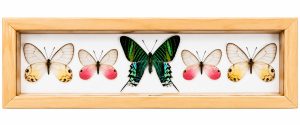
At The Butterfly Connection, many of our framed butterfly specimens highlight species commonly studied by scientists, offering a tangible connection between natural beauty and biological research.
Butterflies are not passive decorations of nature—they are active learners, shaped by their environments and experiences.
📚 Learn More: Trusted Science Resources
For readers who want to explore butterfly cognition and insect learning further:
🦋 A New Way to Think About Butterflies
The next time a butterfly drifts past—or hangs quietly in a frame—remember this: it has learned, adapted, and carried memory through one of the most dramatic transformations in nature.
Beautiful, yes.
But also intelligent, resilient, and endlessly fascinating.








29 thoughts on “Do Butterflies Have Memory? What Science Reveals About Learning in Insects”
Pingback: propecia medication
Pingback: fluconazole 200 mg
Pingback: metoprolol tart
Pingback: 30 mg prevacid over the counter
Pingback: doryx 75 mg
Pingback: amoxicillin clavulanic acid
Pingback: furosemide 20 mg price
Pingback: vibramycin generic
Pingback: nexium 40 mg
Pingback: sildenafil bpjs
Pingback: xenical weight loss
Pingback: avanafil price australia
Pingback: semaglutide vergoedingscriteria
Pingback: semaglutida preço comprimido 7mg
Pingback: cialis pills images
Pingback: doxycycline for acne prescription
Pingback: doxycycline oral suspension for dogs
Pingback: acyclovir 400 mg blue pill
Pingback: toradol short term medical guidance
Pingback: ivermectin for inflammatory rosacea
Pingback: minoxidil pharmacological mechanism
Pingback: avanafil contraindication overview
Pingback: vardenafil vs sildenafil full comparison
Pingback: orlistat common side effects
Pingback: amoxicillin general information
Pingback: penicillin allergy reaction overview
Pingback: Sildenafil Peak Timing
Pingback: learn what sildenafil is used for
Pingback: this Indian tadalafil overview