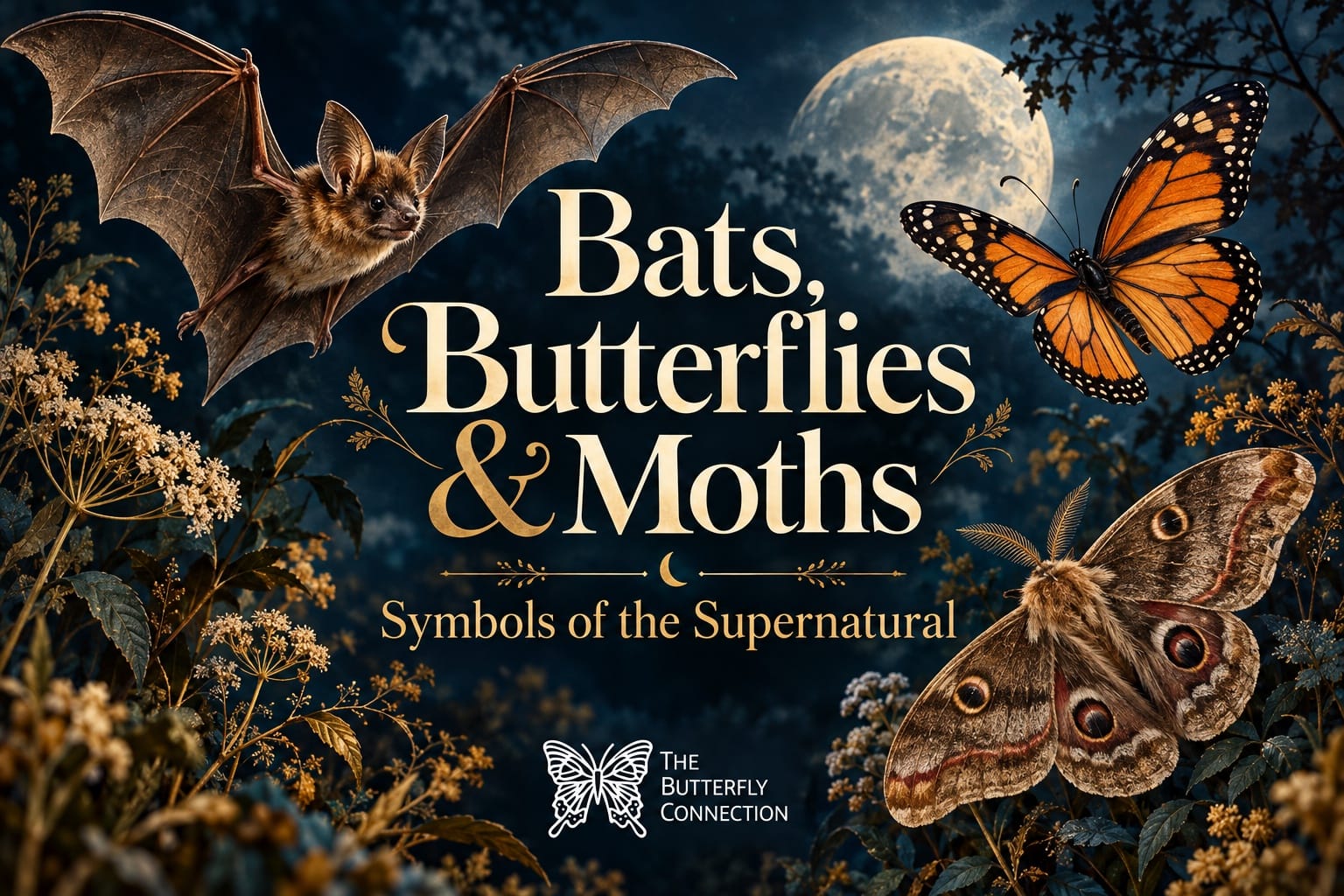
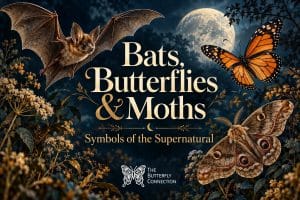
A butterfly settles on a flower. A moth appears beside a porch light. A bat crosses the evening sky.
Each encounter lasts only a moment, but it can leave us with a story. Was the butterfly a reminder of someone we miss? Does the moth seem mysterious? Why does a bat feel so perfectly at home in a Halloween scene?
The supernatural symbolism of winged creatures tells us as much about human imagination as it does about the animals themselves. Their shapes have appeared in objects that express love, happiness, fear, and ideas about the soul.
But there is no single meaning attached to a pair of wings. A creature that looks ominous in one setting can carry a hopeful message in another. Three examples—from classical art, Chinese decorative traditions, and the reputation of an unusually marked moth—show how differently people can interpret the natural world.
Butterfly wings and the image of the soul
A butterfly is an evocative image for something difficult to hold onto. Its wings look delicate, its movement can be fleeting, and its emergence from a chrysalis gives artists a powerful visual language for change.
In classical tradition, the figure of Psyche connects butterfly imagery with the soul. York Museums Trust discusses Psyche and butterflies in historical art, while a terracotta figure in the British Museum gives that connection a tangible form: Psyche is depicted with butterfly wings.
The detail changes how you look at the figure. These are not simply wings added to make a person look magical. They belong to an artistic tradition in which the butterfly helps express an idea about human existence.
That is also what makes this symbolism interesting beyond mythology. A butterfly can become a personal image for a new beginning, remembrance, or a change someone is living through. Those meanings come from the viewer’s experience; they do not require a butterfly encounter to be a supernatural event.
When a bat brings a wish for happiness
A bat silhouetted against the moon is familiar October imagery. Yet a bat decorating a Chinese robe can communicate something very different.
The Metropolitan Museum of Art’s eighteenth-century ceremonial robe features groups of five bats. The museum explains the wordplay behind them: the Chinese words for bat and happiness sound alike. Five bats express wishes for longevity, health, wealth, virtue, and a natural death.
Look at that garment and the animal becomes part of a message of good fortune. The wings have not changed; the cultural context has.
Bat Conservation International’s exploration of lucky bats describes their appearance across decorative objects, from furnishings to personal accessories. Their designs can be highly stylized, so recognizing the motif helps reveal a message that might otherwise be easy to miss.
This is a useful reminder when reading folklore: a familiar animal does not carry the same meaning everywhere. A bat can suggest unease in a modern spooky scene and happiness in a particular artistic tradition. Neither interpretation describes what every person in that culture believes.
The moth whose markings became an omen
Some supernatural associations begin with a striking physical detail.
The death’s-head hawkmoth has a marking on its thorax—the body section behind its head—that resembles a skull. It can also make a squeaking sound. Butterfly Conservation notes that this combination contributed to its traditional reputation as an omen of death.
It is easy to see why the resemblance catches our attention. Once someone points out the skull-like shape, it can become the first detail a viewer notices.
But the marking is part of an insect’s appearance, not a prediction. A frightening interpretation can attach itself to an ordinary feature of an animal’s body and then travel through stories.
Its reputation belongs to the history of how people have interpreted it. The moth itself remains an animal worth observing closely.
Why wings make room for stories
These examples do not establish a single origin for supernatural symbolism. They suggest several ways an animal can become a symbol.
In the depiction of Psyche, butterfly wings give visible form to an idea about the soul. In the Chinese bat motif, language and decorative art work together to express a wish. In the death’s-head hawkmoth’s reputation, a resemblance becomes the starting point for an ominous interpretation.
One way to understand their shared appeal is to think about the viewing experience. Wings can be seen clearly in one moment and disappear from view in the next. A still outline becomes motion. A small pattern can suddenly look like something familiar.
That is an interpretation of their appeal, rather than proof of why a particular tradition began. The documented objects and accounts matter because they let us move beyond vague claims that everyone, everywhere, believed the same thing.
They also give us a better question to ask: whose story are we looking at, and what did this image mean in that setting?
Supernatural symbolism and the pleasure of looking closer
October offers plenty of reasons to enjoy a mysterious silhouette. Natural history gives us reasons to stay interested after Halloween.
A framed moth invites you to follow its wing outline. A butterfly arrangement lets you compare patterns without trying to follow an insect in flight. A preserved specimen can turn a familiar shape into something you want to examine more carefully.
At The Butterfly Connection, our framed Green Urania moth and resin-encased bat display offer different ways to enjoy those visible details. Each offers an invitation to pause and look closely.
Perhaps you are drawn to the stories. Perhaps you simply love a wing pattern, an unusual shape, or a piece that makes you stop and look.
Explore The Butterfly Connection’s art, jewelry, and natural-history specimens and find the details that speak to you.
Frequently asked questions
Do butterflies have one universal spiritual meaning?
No. Butterfly imagery has different meanings across artistic traditions and personal experiences. Psyche’s butterfly wings are one specific historical example, not an explanation of every butterfly belief.
Why are bats considered lucky in Chinese art?
The words for bat and happiness sound alike in Chinese. Artists use the bat as a visual expression of good fortune, including the five-bat motif associated with five blessings.
Is the death’s-head hawkmoth a bad omen?
Its skull-like marking contributed to that traditional reputation. The belief is folklore; seeing the insect does not predict a death or other misfortune.